 Posted by
 In 2014 I created a new course for first-year students at William & Mary, and taught it as part of their new general education curriculum. It was always one of my favorites, and I taught it many times until I retired. For those who are curious, the final version of the course website, including the reading list, can be found here. [You can also find the reading list below, just in case that legacy link gets broken if/when the university migrates to a new system. ] Think of these readings as crumbs that lay out one path through the history of ideas, with a particular focus on the history of astronomy and cosmology.
Because the course was part of a new curriculum, University Relations also helped me to make a video about it (2:30):
The course was a joy to teach, so I share this material in case others might find it of interest.
Books for the course:
Primary texts:
- The Book of the Cosmos: Imagining the Universe from Heraclitus to Hawking, D.R. Danielson.
- The Knowledge Machine: How Irrationality Created Modern Science, by Michael Strevens.
- The End of Everything (Astrophysically Speaking), Katie Mack.
- At various other times, I’ve used Black Holes and Time Warps, by Kip Thorne; or Life of the Cosmos, by Lee Smolin.
readings and viewings
Key: If a direct link is not provided to an online resource, most of the the readings can be found in [D] = Danielson’s book, or [Blog] = posted on this site.
Part 1: Seeking Sources
- “In the beginning,” Ross Andersen, Aeon (2015).
Humans as storytellers and artists
- “A day in the life of Adam and Eve,” from Sapiens: a Brief History of Humankind, by Yuval Harari.
- “Human evolution is more a muddy delta than a branching tree,” John Hawks, Aeon.
- “How wonder works,” Jesse Prinz, Aeon. (There is a link to an audio version, too, if you prefer listening.)
- Cave art at Lascaux, France (take the online ‘guided tour’, approx. 5 mins.). Compare the Lascaux artists with Picasso’s drawing of a bull [0:27].
Lost worlds and stories of how the world began.
- Archaeoastronomy, Giulio Magli. Chapter 4: Astronomy and Architecture at the Roots of Civilization.
- Some fairy tales might be 6,000 years old, David Schultz, Science Magazine (2016).
- Skywoman falling, Robin Wall Kimmerer, from Braiding Sweetgrass: Indigenous Wisdom, Scientific Knowledge and the Teachings of Plants.
- From Danielson, please read: The Heavens Declare, pps. 6-10 of Danielson [D].
We pick up the Greek thread with the pre-Socratics
- “Introduction: Telescopes for the mind,” pps. xxv-xxxiii [D].
- “Pythagoras,” Bertrand Russell, from A History of Western Philosophy.
- “Twice Into the Same River?” Heraclitus and Permenides [D].
- “Zeno’s Paradoxes: the Arrow,” Prof Angie Hobbs video. [5:56]
- “The Things of the Universe are Not Sliced Off With a Hatchet,” Empedocles and Anaxagoras [D].
- “Atoms and Empty Space,” (read the short sections on Leucippus and Democritus) [D].
We continue by exploring Plato’s moving image of eternity and the enduring interest of the Greek story
- “Plato’s Allegory of the Cave,” TedEd Video, Alex Gendler [4:32].
- “The Moving Image of Eternity,” Plato [D].
- “Why do I study physics?” A film by Shixie (Xiangjun Shi). [3:41]
- The Road to Reality, Roger Penrose. I had them read the Preface and Chapter One: The Roots of Science.
- “New realities are imminent,” David Chalmers interview about virtual reality. [5 mins.]
- For fun: Gods and robots in ancient mythology, Adrienne Mayor interview. [1:03:19]
The Triple-A Threat: Aristotle, Aristarchus, and Archimedes
- “The Potency of Place,” Aristotle [D].
- “Brian Cox Visits the World’s Biggest Vacuum,” Brian Cox, BBC.
- “He Supposes the Earth to Revolve,”Aristarchus and Archimedes [D].
- “Aristarco di Samos,” short video from “Stephen Hawking’s universe” [3 mins.]
- “A Geometrical Argument,” Eratosthenes [D].
- “On Things That Should Never be Forgotten,” Tracy blog.
The Legacy of Alexandria; the Ancient World Forgotten?
- “The Peculiar Nature of the Universe,” Ptolemy [D].
- “Agora: The Most Intelligent Movie on Science and Religion“, Adam Frank, NPR.
- “Greek Astronomy and the Medieval Arabic Tradition,” George Saliba.
A Medieval Sampler
- “From this point hang the heavens,” Dante Alighieri [D].
- “The medieval senses were transmitters as much as receivers,” Wollgar, Aeon.
- “If a man were in the sky and could see the Earth clearly,” Nicole Oresme [D].
- “A single universe in which each star influences every other,” Nicholas Cusanus [D].
The Copernican Revolution’s quiet beginnings
- “Almost contrary to common sense,” Nicolas Copernicus [D].
- “The poetic structure of the world,” Hallyn and Kuhn [D].
- “A star never before seen in our time,” Tycho Brahe [D].
- “This little dark star wherein we live,” Thomas Digges [D].
Part 2: The Martian Catastrophe and its Aftermath
The hard work of learning to see in new ways
- “The Great Martian Catastrophe and how Kepler fixed it,” Owen Gingerich.
- “Neither known nor seen by anyone before,” Galileo Galilei [D].
- “Learning to see,” Tracy, American Scientist.
Descartes and Newton
- “Descartes,” Bertrand Russell, A History of Western Philosophy.
- “A very liquid heaven,” René Descartes [D].
- “I feel, therefore I am,” Margaret Wertheim.
- “Into the celestial spaces,” Isaac Newton [D].
This was the midway point, so take a breather…
The Scientific Revolution Gets Underway
- The Introduction and Part 1 of The Knowledge Machine, by Michael Strevens.
- “Must we then reject the infinitude of stars?” HWM Olbers [D].
WE learn how far away the stars are through increasing precision
- Part 2 of The Knowledge Machine.
- “Astronomers mark time,” Schaffer. [Here’s a link to the original, which is behind a paywall, alas.]
- I had the students sign up for a citizen science project through Zooniverse. Check it out here.
- For fun: Listen to the podcast “Connecting physics to the world of experience,” where physicist Sean Carroll and philosopher Jenann Ismael discuss free will.
We learn what stars are made of through spectroscopy:
- Finish the rest of The Knowledge Machine.
- “Unraveled starlight,” WIlliam Huggins [D].
- “Spectroscopy and the birth of astrophysics,” Am. Inst. of Phys. website.
The pace of Discovery accelerates:
- “The shadow! The shadow!” Maria Mitchell [D].
- “Astronomy still young,” Agnes Mary Clerke [D].
- “The architecture of the celestial mansions,” Annie Jump Cannon [D].
- “The quickening influence of the Universe,” Cecelia Payne-Gaposchikin [D].
- “Sky Readers,” Tracy, Aeon.
Interlude: Into the 4th dimension
- “The fourth dimension in 19th century physics,” Bork.
- “The time machine,” HG Wells. Read the first chapter.
Part 3: Relativistic cosmology arrives on the scene
- “The man in the accelerated chest,” Albert Einstein [D].
- “When Albert Einstein and Henri Bergson rowed about time,” Economist, April 9, 2022.
- “A science without time,” Tracy, Aeon.
- Spacetime Physics, Taylor and Wheeler. Please read up to page 20.
- “Simultaneity: Einstein and the Special Theory of Relativity,” short video (2 mins.).
- “Can you go the speed of light?” Veritasiuum video (5 mins.).
- “Special relativity and the twin paradox,” Physics Girl video (5 mins.).
- “What would it look like if someone threw a baseball at you at 90% lightspeed?” Randall Munroe.
We discover the universe is expanding and how strange it can be:
- “The realm of the nebula,” Edwin Hubble [D].
- “Prisons of light,” Kitty Ferguson [D].
- “What we cannot see yet know must be there,” Vera Rubin [D].
- Also, please read the first four chapters of The End of Everything (Astrophysically Speaking), Katie Mack.
Did the universe have a beginning? Will it have an end?
- “Did the expansion start from the beginning?” Geoges Éduard Lamaitre [D].
- “Science, religion, and the Big Bang,” Maria Popova, Brain Pickings. Be sure to watch the embedded video, which is a great quick summary of why “Big Bang Theory” should instead be called the “Everywhere Stretch Theory”. (video is 5:19 long)
- Please read the rest of The End of Everything, by Katie Mack.
- Please listen to the Sean Carroll interview with Adam Riess “On the expansion of the universe and the crisis in cosmology.” (1:18:18 in length) Riess was one of three people (Perlmutter and Schmidt were the other two) who were awarded the Nobel Prize in Physics for their discovery that the universe appears to be accelerating, which is is the best evidence we have for the existence of what’s called ‘dark energy’.
Copyright © Eugene R. Tracy. All rights reserved. If you enjoyed this piece, please share it, while respecting the Terms of Use.
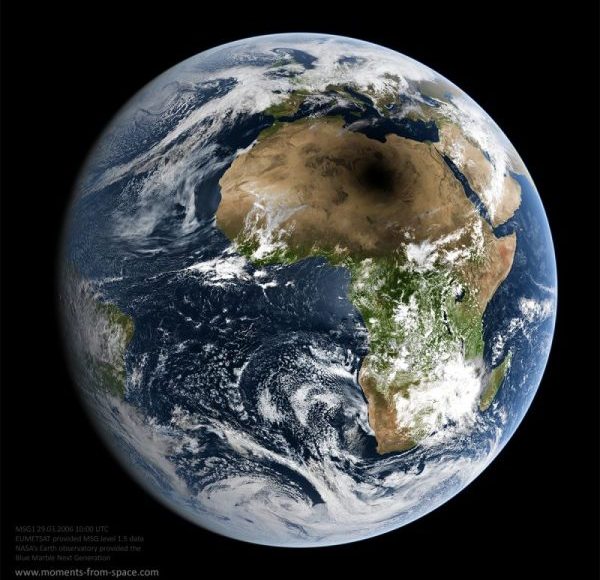
Image: Solar eclipse as seen from space. Note the dark patch in the Sahara Desert. The ‘Blue Marble Next Generation’, NASA.
 The Icarus Question