 Posted by
 (2000 words)
If our civilization survives the coming upheavals, universities will too, even if their form and function changes—because universities are what makes our civilization possible.
‘The book carries us, in a manner, into company; and unites the two greatest and purest pleasures of human life, study and society.’—David Hume, Dialogues Concerning Natural Religion
Do a Google search that begins with: ‘academia is’. The autocomplete function, peering into the global hive-mind, came up with the following answers in late 2022: academia is ‘broken’, ‘toxic’, ‘dying’, ‘pointless’, ‘not a meritocracy’, ‘abusive’, or ‘a cult’. And ‘academia is killing me.’ What has happened to the dreaming spires?
The trench warfare of campus politics, the budget battles, the internal insurgencies, the tendency of faculty to circle the wagons and shoot inwards, the paucity of jobs—these mutually reinforcing trends feed the sense that something is terribly wrong. In such an environment, we can readily forget what we are fighting for, and why it truly matters.
With their mission to preserve, transmit and enlarge human knowledge, universities should find themselves working at the nexus of social transformation, as engines, beneficiaries, and sometimes victims, of that change. It’s therefore puzzling that so many discussions about the future of the university slip into narrow and practical concerns, diagnosing broken funding models, and focusing on workforce needs to the exclusion of long-term student wellbeing. If we talk only of value propositions and return on investment, of lifetime earnings and payback, we risk missing what’s really at stake.
Universities can sometimes be difficult to love, yet their ideal continues to inspire. We need a new and better vision of the university, one more in tune with its current reality. Yet we also need a picture that remains faithful to the deeper values of the academy, the values that are worthy of love. As the philosopher David Hume argued, the shared pursuit of learning can unite two of the purest pleasures of life: study and the company of others.
* * *
The writer Robert Bringhurst has argued that poetry is what we do when we think deeply, breaking through the crust of the familiar to touch a more fluid layer of thoughts hidden below. If those thoughts emerge as words, they become what is traditionally understood as a poem. But our thoughts can manifest in many other ways, too. An invention can be thought of as a ‘maker-poem’. A new theory of space and time might be a ‘physics-poem’, while a theorem can be a ‘math-poem’.
I like this notion of deep-thinking-as-poetry because it encourages us to avoid distracting surface differences. Instead, we can come to see the artist and scientist, the thinker and the maker, the teacher and student, as engaged in the same vital species-wide project: the quest to know ourselves better, so as to find our way in a dangerous world.
Universities have been a part of that human social project for nearly a millennium. They have survived wars and famines, revolutions and plagues. They are among the longest-lived of human institutions and tend to be far more robust than governments or business enterprises. In his book The Uses of the University (1963), University of California Chancellor Clark Kerr noted that of the Western institutions in continuous existence since 1500, only about 80 survive. These include the Catholic Church; the parliaments of England, Iceland, and the Isle of Man; a very few family-owned companies; and over 70 universities. This remarkable longevity alone should give us pause when politicians and business leaders confidently declare that they know best what universities need to do and be. It’s highly likely that universities will change in form and design in coming decades, and that we might even invent new kinds of universities. Still, they will almost certainly survive current social upheavals, assuming our civilization itself survives them, precisely because the university’s mission to preserve, transmit, and enlarge human knowledge is what makes civilization possible.
But rather than cling to any single expression of this aspiration, it is the aspiration itself that we should fight to preserve. And we must acknowledge that this dream draws its strength from a very deep and universal human yearning to learn from, and with, other people. Productive rumination about the future of the university means not only struggling with the important matter of the economics of higher education, and the wider social impacts of university programs. It also requires that we remain alive to the poetics of the university: attending to how we see the university when we call it up in our imaginations; how we think about its role in the world; the stories we tell of it; how we imagine its past and future. And, most importantly, how we dream about the kinds of lives that universities make possible.
The history of the university is not a single story, and there is no reason to believe the future of the university will be simple either. There is also no single, true measure against which all institutions should be judged. Instead, we ought to see that modern universities are complex and prone to change, and that they are a disorderly collection of programs and schools that evolve and adapt. Despite clickbait claims that we face a future with only ten universities, there is no reason to believe we are converging toward a single model, or toward global uniformity, and certainly no reason to think that this would be a good thing.
Although it might be argued that the tendency of capitalism and market economics pushes everything toward commodified uniformity, this is a transient phenomenon when viewed within a longer time frame. Such a trend toward homogeneity among universities would violate all the norms of evolutionary processes, which in fact militate against monocultures and instead tend toward highly diverse ecosystems. Monocultures are fundamentally unstable, less resilient in the face of shocks from changing environments. It’s the nonuniform, complex, and manifold nature of universities that explains their remarkable longevity. Precisely because universities are organic entities, governed by laws of variation and selection, they are also full of puzzling inherited traits. Like all living things, they embody their history. They are not designed so much as adapted to the current moment by way of contingent and often haphazard processes. The university is older than capitalism and Marxism, and neoliberalism is merely middle aged; it’s a good bet the evolving and hybridizing university will outlive them all.
* * *
In an interdisciplinary course I used to teach with several colleagues called ‘The Idea of the University’, we asked our students to go through the exercise of drafting a charter for their ideal institution. We encouraged them to think about why their university existed, what role they wanted it to play in the world, who got to govern it, and how decisions would be made. We asked: what would you do differently? What would your ideal university value most? Would it be a global entity, living online, fully embracing a virtualized future? Or would it harken back to the original academy, set in a grove of ancient trees, close to the earth, sea, and sky, a place of physical presence and long conversations, surrounded by nature? Would your ideal university focus on serving inner cities or rural towns, indigenous communities, or isolated island nations, providing access to students who would otherwise never dream of going to university? Or would you focus primarily on charting a course into a more traditional academic stratosphere, dedicated to the creation and preservation of arcane knowledge, a true ivory tower?
Our students collectively wanted all these models represented among future universities. In a world as prone to disruptive change as ours, a world of uneven development and even more uneven wealth and privilege, there is no reason why we should limit our imaginations to one stereotype of the university in our 21st century stories. We should not restrict our imaginings to sylvan quads or cloistered courtyards, tree-lined walks or pebbled paths, theatre seating for large lecture classes where professors drone and students doze. We need new and better stories about the 21st century university, stories and poems that feed our dreams about what’s possible.
The hunger for knowledge is universal, and as parts of the world long left behind shake off the lingering impact of colonialism, more and more people are pursuing education. According to the website Our World in Data, only 12 percent of the world’s population could read and write in 1820. Today, that is roughly the fraction of people who remain illiterate. Universal literacy is no longer a dream, it is a near-term reality. Generation upon generation, as levels of education increase, so too does the demand for more advanced instruction. So, while we might think that innovative university designs will be largely technological—the online university, the university that’s fully virtual—it’s also important to remember that those technologies are merely enablers of new social formations and driven by local needs and desires.
For example, during the colonial era, education in many of the more remote islands of the South Pacific was still rudimentary—focused on learning how to read and write sufficiently well to serve on colonial plantations, and to read the Bible. But after the Second World War, and with the coming of self-determination, several newly formed island nations set out to create educational systems for their citizens. To do so, they had to invent a new kind of university. The University of the South Pacific was founded in 1968 as a collaboration of twelve island nations with a total land area about that of Denmark. It now serves a population of over a million people spread over 33 million square miles of the Pacific—a sea surface area larger than the entire Eurasian landmass.
There is also the University of the West Indies (UWI), based in Jamaica and founded in 1948. The UWI is a collaboration among the 17 English-speaking island nations of the Caribbean. When I met the Jamaican novelist Erna Brodber on a visit to my university, she told me that as a student of history at UWI in the early 1960s, she learned a lot about Scottish history but nothing about Jamaican history. So, after her PhD, instead of pursuing the usual academic paths in US or British universities that would have required her to focus on a more traditional and narrow form of research, she decided instead to write novels, largely based on oral histories she’d collected from her own people. Brodber’s critique of the narrow focus of university history education in past generations highlights the fact that there are many stories that have been overlooked or left out. Challenging the university from outside its walls in this way can also be a form of love for the idea of it, goading the university to enlarge its vision and remain true to the values it claims to represent.
Not far from where I live there was once an open field next to a shopping mall. I read an article in a local newspaper that described how, every few months, a truck would arrive loaded with lumber, and an old man would be there to receive it. Then, all by himself, he would set about building what I like to think of as his university. A frame went up here, a doorway there, a window over there. After a few days his wife would come. She would follow the lumber truck back to the building site, apologetic and thankful that the company was willing to take back most of the delivery. Then she would gather up her husband to go back home, where he began to dream once more of his university. Like him, we need to continue the essential work of dreaming about the kinds of universities we will want to build. Our civilization demands it.
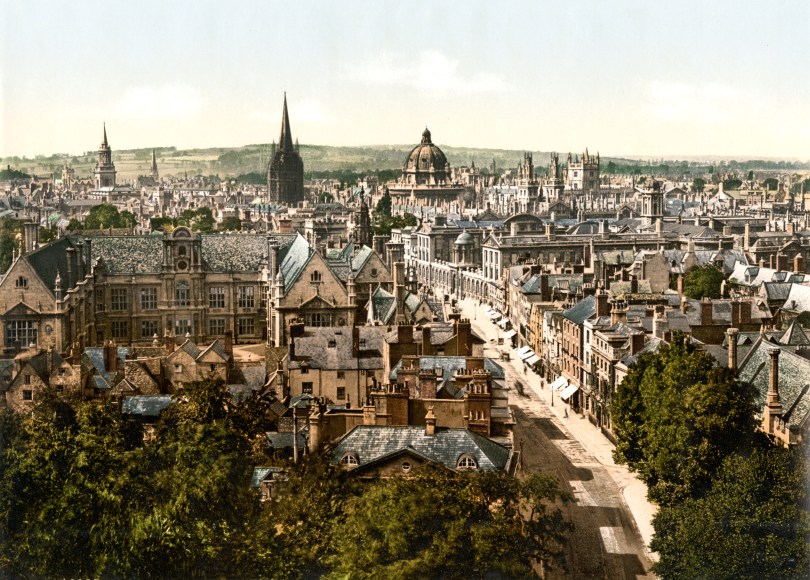
Image: High Street, Oxford, 1890s. Photoglob Zürich, reprinted by Detroit Publishing Co. [Public domain]

The text is licensed under a Creative Commons Attribution-NoDerivatives 4.0 International License.
 The Icarus Question
Hello! Someone in my Myspace group shared this website with us so I came to give it a look. I’m definitely loving the information. I’m book-marking and will be tweeting this to my followers! Exceptional blog and superb style and design.
LikeLike
Thanks, Shani. Glad you like it.
LikeLike
very interesting subject , outstanding post.
LikeLike